
Complete Guide to Sponge Iron (DRI) Briquetting: Production, Advantages, and HBI Technology
What Is Sponge Iron (DRI)?
Sponge iron, also known as Direct Reduced Iron (DRI), is a metallic iron product produced by reducing iron ore using reducing gases such as hydrogen (H₂) and carbon monoxide (CO) at temperatures below the melting point of iron.
The term “sponge iron” comes from its porous structure formed during the reduction process. Under a microscope, the material resembles a sponge with numerous pores.
Typical sponge iron properties:
- Bulk density: 1.6–1.9 g/cm³
- Apparent density: 3.4–3.6 g/cm³
- Particle size: 4–20 mm
In addition to metallic iron, sponge iron also contains:
- Unreduced iron oxides
- Silica (SiO₂)
- Alumina (Al₂O₃)
- Phosphorus oxides and gangue materials
Because impurities are not separated during direct reduction, all gangue materials remain in the final DRI product.
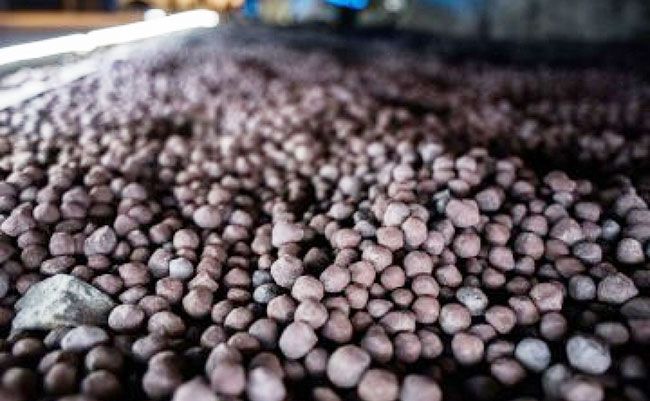
Direct reduced iron stored in a warehouse
How Sponge Iron Is Produced
Sponge iron is produced by reducing iron ore concentrate with hydrogen or other reducing gases. Typically, the iron ore is loaded into a reactor and reacted with hydrogen gas, carbon monoxide gas, or solid reducing agents at temperatures below the softening point of the iron ore, without producing molten iron or slag. During the reaction process, only the oxygen in the iron oxide is removed, resulting in porous metallic iron known as sponge iron.
There are many types of direct reduction processes, such as the shaft furnace process (HYL), the vertical furnace process (typical: Midrex), the rotary kiln process (typical: SL/RN), and the rotary hearth furnace process (typical: FASTMET), among others. At present, more than 40 different processes have been used for the production of sponge iron. However, so far, over 50% of direct reduced iron produced in steel plants is manufactured using the Midrex process.
Midrex Sponge Iron Process
The Midrex process is a typical shaft furnace direct reduction technology.
Main equipment includes:
- Shaft furnace
- Reformer
- Heat recovery system
Shaft Furnace Reduction
Oxidized pellets are charged from the top of the furnace and move downward by gravity.
Inside the furnace:
- The upper zone performs preheating and reduction at approximately 1000°C
- The lower zone carburizes and cools the DRI to below 550°C before discharge
Reducing gases containing hydrogen and carbon monoxide flow counter-currently through the burden.
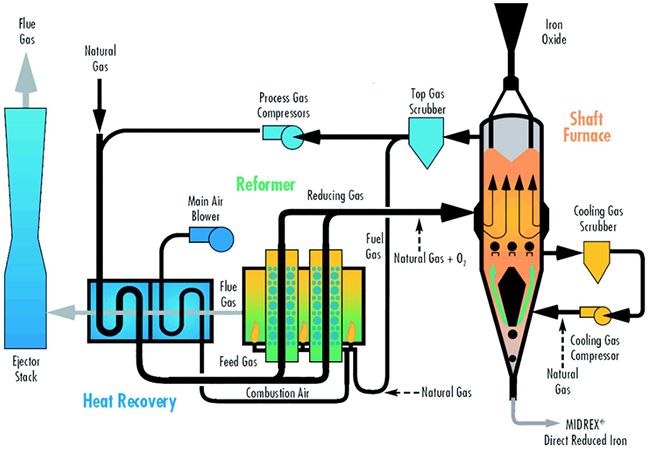
Typical Midrex DRI production process
Midrex Reformer System
Natural gas is the primary reducing gas source.
In the reformer:
- Natural gas mixes with recycled top gas
- Catalytic reforming produces H₂ and CO
- High-temperature reducing gas enters the shaft furnace
This provides efficient and continuous iron ore reduction.
Waste Heat Recovery
The Midrex process features an advanced sensible heat recovery system.
Recovered heat is used to:
- Preheat combustion air up to 675°C
- Preheat mixed process gas up to 540°C
This reduces thermal energy consumption significantly:
- From over 14.63 GJ/t in early systems
- To approximately 9.85 GJ/t today
Why Briquette Sponge Iron?
During handling or transportation of reduced sponge iron pellets, the hard and coarse pellets are subject to abrasion, generating fine particles. These fines are difficult to handle. They can be used as a sintering additive, or more directly as an iron-bearing material in basic oxygen furnaces or electric arc furnaces.
Fine-grained direct reduced iron (DRI) produced by the fluidized-bed process without passivation treatment cannot be stored in the open air, and storing metallized sponge iron pellets outdoors is also very difficult. Small pile storage is beneficial for dissipating the heat generated by oxidation reactions and can help suppress spontaneous combustion. However, large pile storage reduces surface exposure and effectively minimizes re-oxidation. Therefore, provided that spontaneous combustion is prevented, large pile storage should be adopted.
The ideal storage method for direct reduced iron (DRI) is to keep it in clean, waterproof, and sealed silos. When DRI is transported over long distances by land or sea, it is preferable to first undergo passivation and briquetting treatment; for fine-powder products produced by the fluidized-bed process, passivation and briquetting are essential before storage and transportation.
Advantages of Sponge Iron Briquettes
Compared with loose DRI, sponge iron briquettes offer several advantages:
| Advantage | Description |
|---|---|
| Higher Density | Reduces transportation cost |
| Better Oxidation Resistance | Improves storage safety |
| Lower Water Absorption | Reduces re-oxidation risk |
| Stable Carbon Content | Improves steelmaking performance |
| Lower Dust Generation | Reduces material loss |
Hot Briquetted Iron (HBI)
Hot Briquetted Iron (HBI) is produced by compressing hot DRI at temperatures of 650–700°C under extremely high pressure.
The result is a dense pillow-shaped briquette with:
- Higher mechanical strength
- Better resistance to oxidation
- Excellent transportability for long-distance shipping
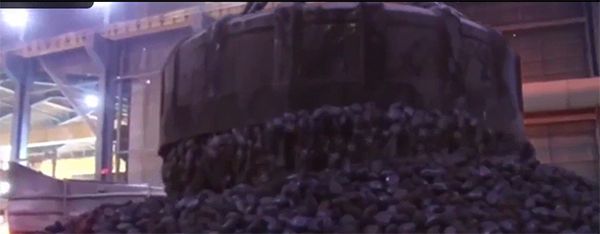
HBI stored in an outdoor stockyard
Applications of Sponge Iron in Steelmaking
Sponge iron is widely used in:
- Electric Arc Furnaces (EAF)
- Basic Oxygen Furnaces (BOF)
- Converter steelmaking
- Powder metallurgy
- High-quality and special steel production
Most sponge iron is consumed in electric furnace steelmaking.
Advantages of Sponge Iron in EAF Steelmaking
- The bulk density of sponge iron briquettes is higher than that of steelmaking slag, allowing them to penetrate into the slag layer. This not only enables rapid melting but also helps prevent secondary oxidation. If the sponge iron briquettes are of high quality (Grade I), the steel yield can reach over 85%; in general, the steel yield can be no lower than 80%.
- Sponge iron briquettes have a low carbon content. When used as a cooling agent in a basic oxygen furnace, they are highly advantageous because they have little impact on the carbon content of molten steel. This can shorten the smelting cycle and increase daily production output.
- Sponge iron briquettes have a stable chemical composition and low levels of harmful elements, which is a unique advantage of sponge iron. When producing high-quality steel or special steels, only the addition of sponge iron or high-grade scrap steel can ensure that the chemical specifications of the molten steel meet the required standards. However, high-quality scrap steel may suffer from inconsistent quality and the presence of inclusions; therefore, sponge iron briquettes are the preferred choice.
- Sponge iron briquettes also contain a small amount of unreduced iron oxide, which is beneficial for decarburization during the later stage of steelmaking.
- Each individual sponge iron briquette is lightweight and easy to handle and use.
Sponge Iron vs Scrap Steel
- Scrap steel contains a large amount of non-metallic inclusions, high levels of harmful elements, and inconsistent quality. In contrast, sponge iron briquettes have a very high level of purity.
- Although the bulk density of scrap steel is higher than that of sponge iron briquettes, sponge iron briquettes can still penetrate the slag layer without difficulty. When high-quality sponge iron briquettes are used, the steelmaking yield is comparable to that achieved with scrap steel, showing no significant difference.
- Scrap steel needs to be cut before use, whereas sponge iron briquettes do not require cutting.
- Depending on the quality and amount of scrap steel added, the smelting cycle may be extended because scrap steel contains many non-metallic inclusions. When the content of harmful elements and major impurities is high, additional smelting time is required. In contrast, sponge iron briquettes have very high purity, and their addition does not require extending the smelting time.
Sponge Iron vs Pig Iron
- Pig iron has a high carbon content, typically around 4%. When used as a cooling agent in a basic oxygen furnace, it significantly affects the carbon content of molten steel, requiring repeated blowing and thereby extending the smelting time. In contrast, sponge iron briquettes have a low carbon content and have only a minimal impact on the carbon level of molten steel, which helps shorten the smelting time.
- Pig iron contains relatively high levels of harmful elements such as sulfur and phosphorus. When added in the later stage of smelting, it can significantly affect the chemical composition of molten steel. In contrast, sponge iron briquettes have a very high purity, which helps avoid this problem.
- Pig iron is relatively expensive in the market, whereas sponge iron briquettes are comparatively lower in price.
Sponge Iron Briquetting Machine
Sponge iron fines are mainly compacted using roller briquette presses.
The process includes:
- Mixing DRI fines with binders
- Feeding material between two counter-rotating rollers
- Compressing material into briquettes
- Discharging finished briquettes automatically
Because sponge iron requires high compaction pressure, the briquetting machine must have:
- Reinforced rollers
- High-pressure hydraulic systems
- Heavy-duty transmission systems
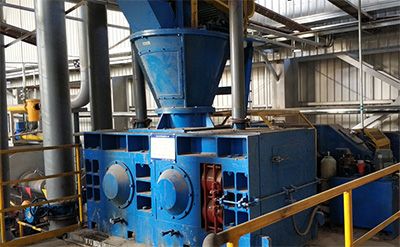
Roller briquette machine for sponge iron fines
Sponge Iron Briquette Production Line
A basic sponge iron briquetting plant usually includes:
- Batching system
- Mixing system
- Briquetting system
- Conveying equipment
- Dust collection system
Large-scale EPC projects may also include:
- Automatic control systems
- Screening equipment
- Cooling systems
- Heat recovery systems
HBI Production System
A typical HBI production plant includes:
- HBI briquetting machine
- Screw feeder system
- Hot screening equipment
- Product cooler
- Bucket elevator
- Chutes and conveyors
Sponge Iron Briquetting Process
Cold briquetting of sponge iron requires adding suitable binders to improve strength and formability.
Typical process:
- DRI fines and binders are mixed evenly
- Material is fed into the briquette press
- Briquettes are formed under high pressure
- Finished briquettes are cured or directly packaged
The final products can be:
- Used directly in steelmaking
- Transported and sold commercially
Sponge Iron Briquetting System Cost
A sponge iron briquetting system is relatively compact, but the final investment depends on many factors:
- Raw material characteristics
- Capacity requirements
- Automation level
- Binder formulation
- Dust control requirements
- Cold briquetting (CBI) or hot briquetting (HBI)
Generally:
- CBI systems have lower investment costs
- HBI systems require significantly higher investment
Customized engineering solutions are usually required according to customer needs.
Conclusion
As green steelmaking and electric arc furnace production continue to expand worldwide, sponge iron (DRI) is becoming increasingly important in modern metallurgy.
Compared with scrap steel and pig iron, sponge iron offers:
- Higher purity
- Stable composition
- Lower harmful elements
- Better suitability for premium steel production
Meanwhile, HBI and sponge iron briquettes provide:
- Safer storage
- Lower transportation costs
- Better resistance to oxidation
- Improved steelmaking efficiency
With the development of hydrogen-based direct reduction technologies, sponge iron is expected to play a key role in the future of low-carbon steel production.


